


What is the MotoGP F-duct? The clever F1-inspired aero idea from Aprilia explained
17 March 2026Aerodynamic development has become one of the fiercest battlegrounds in MotoGP. Winglets and airflow management now play a huge role in acceleration, cornering and braking.
In 2026, Aprilia has introduced one of the most intriguing aero ideas yet: a MotoGP interpretation of the infamous F-duct concept first seen in F1 16 years ago.
Originally pioneered by McLaren in 2010, the system allowed drivers to momentarily reduce drag on the straights and gain extra top speed.
Here’s how Aprilia’s MotoGP F-duct works, where it came from in Formula 1, and why it highlights the growing technological crossover between the two sports.
The origins of the F-duct in Formula 1
The F-duct first appeared during the 2010 Formula 1 season on the McLaren MP4-25, driven by Lewis Hamilton and Jenson Button.
It used a cleverly routed air channel running through the car’s bodywork. Air entered through an intake near the front of the chassis and travelled through the cockpit to the rear wing.
The crucial part of the system was a small opening inside the cockpit. When the driver covered it with their hand or knee:
- Airflow was redirected through the duct
- The airflow disturbed the rear wing
- The wing stalled, dramatically reducing aerodynamic drag
With less drag on the straight, the car could gain up to 10 km/h in top speed.
It was an ingenious workaround in a rulebook that banned adjustable aerodynamic devices but didn’t explicitly forbid a driver-activated airflow system. Rival teams soon copied the idea, but the FIA banned it from the following season due to safety concerns.
How Aprilia adapted the concept for MotoGP
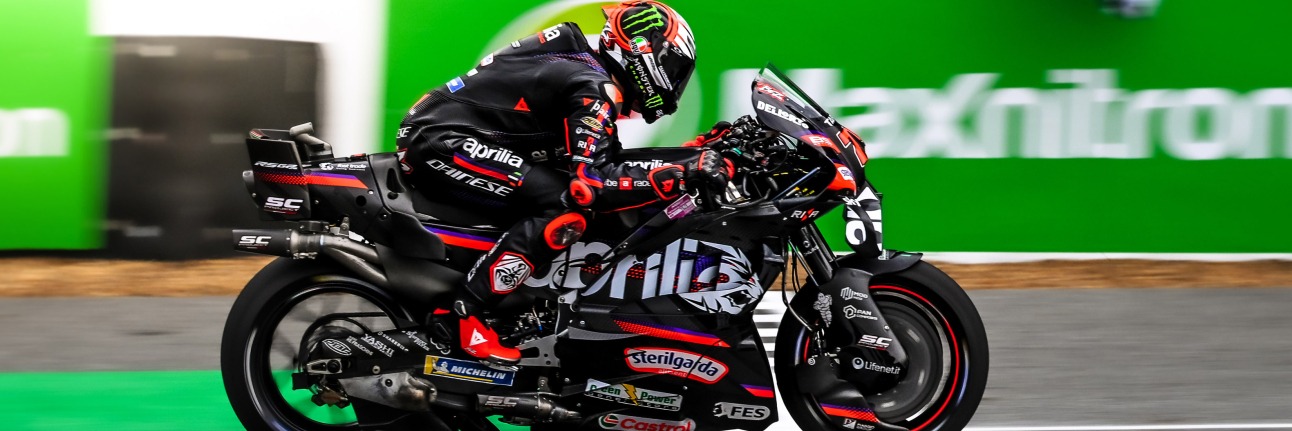
Aprilia has now translated the same idea to the RS-GP MotoGP bike, albeit in a very different guise.
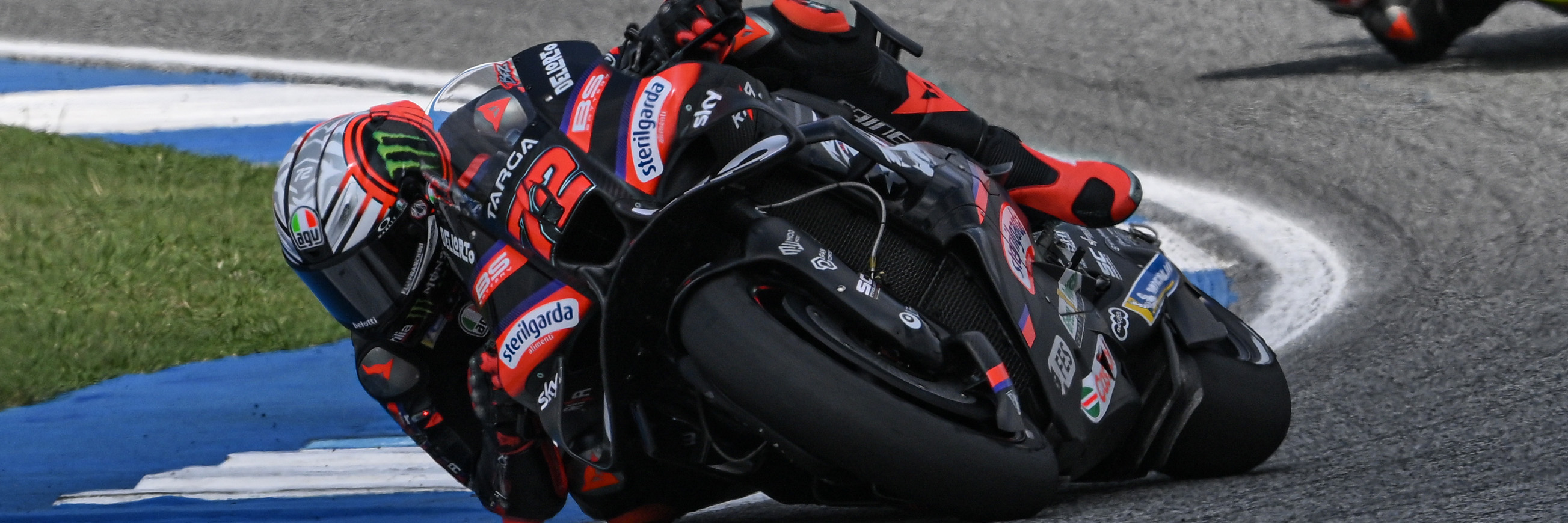
Instead of routing airflow through a cockpit, Aprilia’s version uses a series of small vents and ducts in the fairing.
Two intake vents are positioned at the front of the fairing near the main air intake, while the exit vents located further back on the side fairing, sit under the rider’s forearms when they adopt the classic MotoGP aero tuck, naturally sealing these openings.
That small change appears to trigger airflow separation along the fairing, reducing aerodynamic drag and boosting top speed.
Why Aprilia developed the MotoGP F-duct
Aprilia’s recent aero philosophy has focused heavily on ground-effect style fairings, which help the RS-GP improve cornering performance.
Those designs create pressure differences along the sides of the bike, just like the most recent generation of F1 cars did, improving stability during braking and turning.
The trade-off is that more aggressive aerodynamics often mean more drag, which can hurt top speed on the straights.
The F-duct concept was designed to solve that compromise:
- Maintain strong downforce and stability in corners
- AND reduce drag when tucked on straights
At the 2026 Thailand Grand Prix, Aprilia and Ducati machines recorded speeds of around 345 km/h in the speed trap, suggesting the RS-GP is competitive on the straights despite its aggressive aero package.
Factory rider Jorge Martin said he could feel slightly more airflow while riding, though the change isn’t dramatic from the saddle.
Is the MotoGP F-duct legal?
MotoGP’s technical regulations ban moving aerodynamic devices. Teams cannot install parts that actively adjust position, shape or orientation during a race, but Aprilia’s system bypasses that rule:
- There are no mechanical components that move
- The aerodynamic parts themselves remain fixed
- Only the airflow changes, triggered by the rider’s body position
According to Aprilia Racing CEO Massimo Rivola, the design is fully compliant with the regulations.
MotoGP also limits manufacturers to one aerodynamic update per season, meaning rivals cannot immediately introduce their own version unless they sacrifice another upgrade.
Will other MotoGP teams copy the idea?
In motorsport, clever innovations rarely stay exclusive for long. When the F-duct appeared in Formula 1 in 2010, teams quickly created their own variations before it was eventually outlawed.
The same could happen in MotoGP if the Aprilia system proves to be consistently effective, other manufacturers may try to develop their own airflow-manipulation solutions within the current rules.
However, with MotoGP’s major regulation overhaul planned for 2027, teams may decide the effort isn’t worth it for a concept that could soon become obsolete.
Borrowed innovation
The rebirth of the F-duct shows how closely connected different motorsport disciplines have become. Engineers are constantly studying other series for inspiration, adapting concepts to suit completely different machines.
What began as a clever Formula 1 airflow trick in 2010 has now evolved into a rider-activated aerodynamic system on a MotoGP bike more than a decade later.