

Everything you need to know about British GT 2026 at Silverstone
23 April 2026The 2026 British GT Championship is the 34th edition of the series, and to this day, it remains one of the UK’s absolute best motorsport series and a GT category that is revered across the globe.
Run by SRO Motorsports Group, British GT continues to deliver a potent mix of world-class drivers, supercar grids and multi-class strategy that keeps fans guessing from lights out to the final flag.
Silverstone not only plays host to the season opener in 2026, but also to the only 3-hour race of the campaign on 26 April. Here’s everything you need to know before the cars hit the track.
The classes
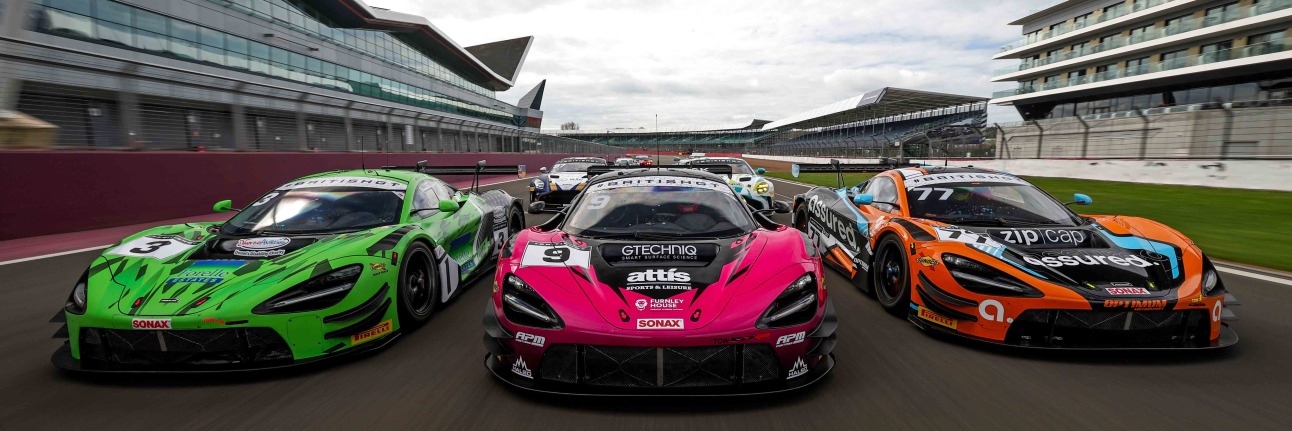
British GT grids are split into two categories: GT3 and GT4, both based on race-prepared versions of road-going supercars.
GT3 represents the top tier, featuring higher performance through advanced aerodynamics and more powerful engines.
GT4, by contrast, focuses on accessibility and close competition, often showcasing emerging talent.
Balance of Performance (BoP) and success penalties are applied across both classes to ensure close, competitive racing throughout the field.
Driver grading
Driver line-ups remain built around the Pro-Am format, pairing professional racers (graded Silver and above by the FIA) with Bronze-rated amateurs.
GT3 continues with Pro-Am and Silver-Am combinations, while GT4 fields a mix of Pro-Am and Silver entries.
A notable evolution for 2026 is the introduction of a refined two-tier Bronze system. Certain drivers may now be classified as “Bronze Plus”, reflecting the growing range of experience within amateur ranks. These drivers may carry additional compensation time or weight to maintain competitive balance.
In GT4, further tweaks aim to simplify competition: Silver class entries no longer carry extra ballast or pitstop penalties, with performance instead equalised through adjusted compensation times.
Points system
Points are awarded to the top 10 finishers in each class. At Silverstone’s 3-hour race, the points system is:
37.5, 27, 22.5, 18, 15, 12, 9, 6, 3, 1.5
Pitstop and drive-time regulations
Strategy is central to British GT, and nowhere more so than at Silverstone.
Mandatory pit stops feature in every race, with longer events requiring multiple stops and strict minimum pit times. Success penalties are applied to top finishers from the previous round, adding extra seconds to their stops.
Driver stint lengths are also regulated to ensure fair participation across Pro-Am pairings, with minimum drive times enforced for each driver depending on class and race duration.
Qualifying format
Qualifying is split by class and driver grading:
- GT3 Q1 followed by GT3 Q2 (Q1 contested by the Am driver)
- GT4 Q1 followed by GT4 Q2 (Q1 contested by the Am driver)
Each session lasts 10 minutes, with a minimum of two timed laps required.
At Silverstone, combined times from both drivers determine the starting grid, with Am drivers taking the opening stint in the race.
Weekend schedule
A full weekend of track action awaits, with practice, qualifying and a headline endurance race forming the core of the event.
Saturday
- Free Practice
- Pre-Qualifying
- Qualifying (split sessions by class and driver grading)
Sunday
- Warm Up
- Race (endurance format)
Support series
British GT is supported by a packed bill of junior and single-make championships across the weekend.
Fans can expect racing from categories such as GB3, GB4 and multiple Ginetta series, ensuring track action from morning to late afternoon on both days.
Ones to watch
- Charles Dawson and Kiern Jewiss – 2025 GT3 champions, back to defend their title this season
- Alex Martin – a consistent GT3 front-runner