
F1 penalties explained: An F101 beginner’s guide to the penalty system
10 October 2025Formula 1 might be the pinnacle of motorsport, but it’s also one of the most tightly regulated disciplines.
Each race is governed by a complex rulebook created and enforced by the FIA, and when drivers or teams step out of line, penalties will often follow.
Minor reprimands, time penalties, and even full race bans are all possible punishments, helping to maintain fairness and safety on the race track.
This guide will take you through the different types of F1 penalties, how they’re decided and administered, as well as what happens if a team or driver appeals.
Why are penalties issued in F1?
Penalties exist to enforce the FIA’s rules and regulations, which cover everything from on-track conduct to the aerodynamic parameters all cars must stay within.
They’re usually handed out for racing incidents – such as collisions, ignoring yellow flags or gaining an advantage off track – but teams can also be punished for breaches like unsafe pit releases, excessive plank wear or cost cap violations.
The severity of the punishment depends on the offence, and it’s up to the stewards to decide what’s fair on a case-by-case basis.
Types of F1 penalties
Warnings and reprimands
Little more than a slap on the wrist, warnings and reprimands are the mildest punishments that aim to deter drivers and teams from similar behaviour in the future.
- Warning: Often used for a first offence, such as exceeding track limits in a race.
- Reprimand: A formal note on a driver’s record. Collect five in one season (if all are for driving offences) and you’ll receive a 10-place grid penalty for the next race.
What is a recent example of an F1 reprimand?
Oscar Piastri received a reprimand for a yellow flag infringement during the FP2 session of the 2025 Azerbaijan Grand Prix.
READ MORE: F1 flags explained
Fines
Drivers or teams can receive fines and can be issued, in some cases, alongside another penalty. They may be given for sporting offences or non-sporting conduct.
Why F1 drivers are fined
Drivers and teams can be fined for breaching the rules and that includes anything from inappropriate language to unsafe pit stops.
Time penalties
One of the most common punishments used when a driver has exceeded track limits and gained an advantage or caused a collision, among other infractions. A time penalty is served by:
- Five or 10 seconds being added to a pit stop, with the car sitting idle before mechanics can touch it.
- Adding the time penalty to their race result if the driver doesn’t stop again.
A high-profile time penalty
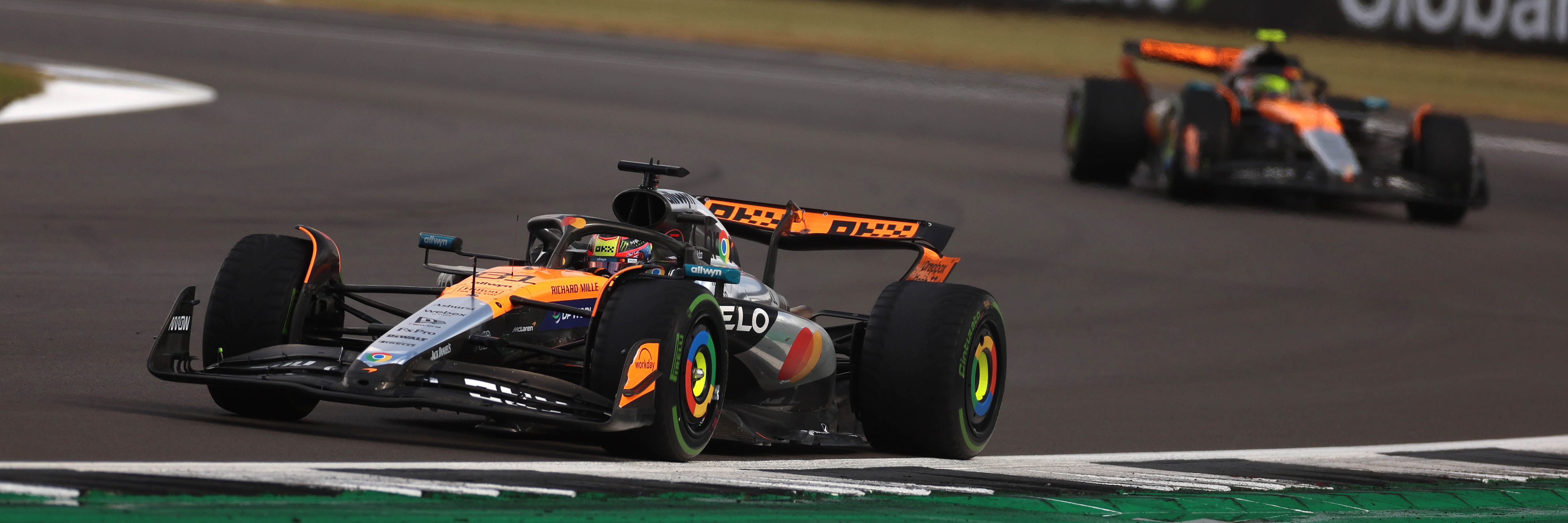
Oscar Piastri received a 10-second time penalty after a Safety Car infringement at the 2025 British Grand Prix, ultimately losing him the race victory to team-mate Lando Norris.
Drive-through and stop-go penalties
The harshest mid-race punishments at the stewards’ disposal are:
- Drive-through: The driver must pass through the pit lane without stopping.
- 10-second stop-go: Even tougher – the driver must stop for 10 seconds in the pit box with no work allowed on the car during the stop.
The most recent stop-go penalty
Due to their severity, stop-go penalties are rarely issued, but Lando Norris was the latest driver to receive one at the 2024 Qatar Grand Prix for failing to slow sufficiently under double-waved yellow flags.
Grid penalties
Applied before a race, grid penalties move drivers down the starting order. They’re often linked to engine or gearbox changes beyond the season’s allocation, though they can also be given for on-track offences such as Lewis Hamilton’s failure to slow for yellow flags on his reconnaissance lap at the 2025 Dutch Grand Prix, resulting in a grid drop at Monza the following race.
Disqualification and suspension
The most severe forms of punishment in F1, reserved for extreme circumstances.
- Disqualification: Removes a driver or team from the results, usually for technical infringements (e.g. an underweight car).
- Suspension: Rare, but forces a driver to miss the next event.
Recent examples
- Disqualification: Both Williams drivers were disqualified from qualifying at the 2025 Singapore Grand Prix for a technical breach on the rear wing.
- Suspension: Kevin Magnussen served a race ban in Azerbaijan 2024 after accumulating 12 penalty points on his Super Licence.
Penalty points in F1: What are they and how do they work?
Alongside other punishments, drivers may be given penalty points on their Super Licence. Points remain on a driver’s licence for a total of 12 months, and reaching a total of 12 points triggers an automatic one-race ban.
Can F1 penalties be appealed?
Yes. Drivers and teams can request a Right of Review if they believe a penalty is unjust, usually presenting new evidence.
How are F1 penalties decided?
During sessions, the Race Director may refer relevant incidents to the stewards, or the stewards can act on what they see themselves. If an investigation is initiated:
- A message appears naming the driver/team involved.
- Stewards review evidence, hear from those involved, and then issue a decision.
- Post-race, hearings may take place for unresolved incidents.